

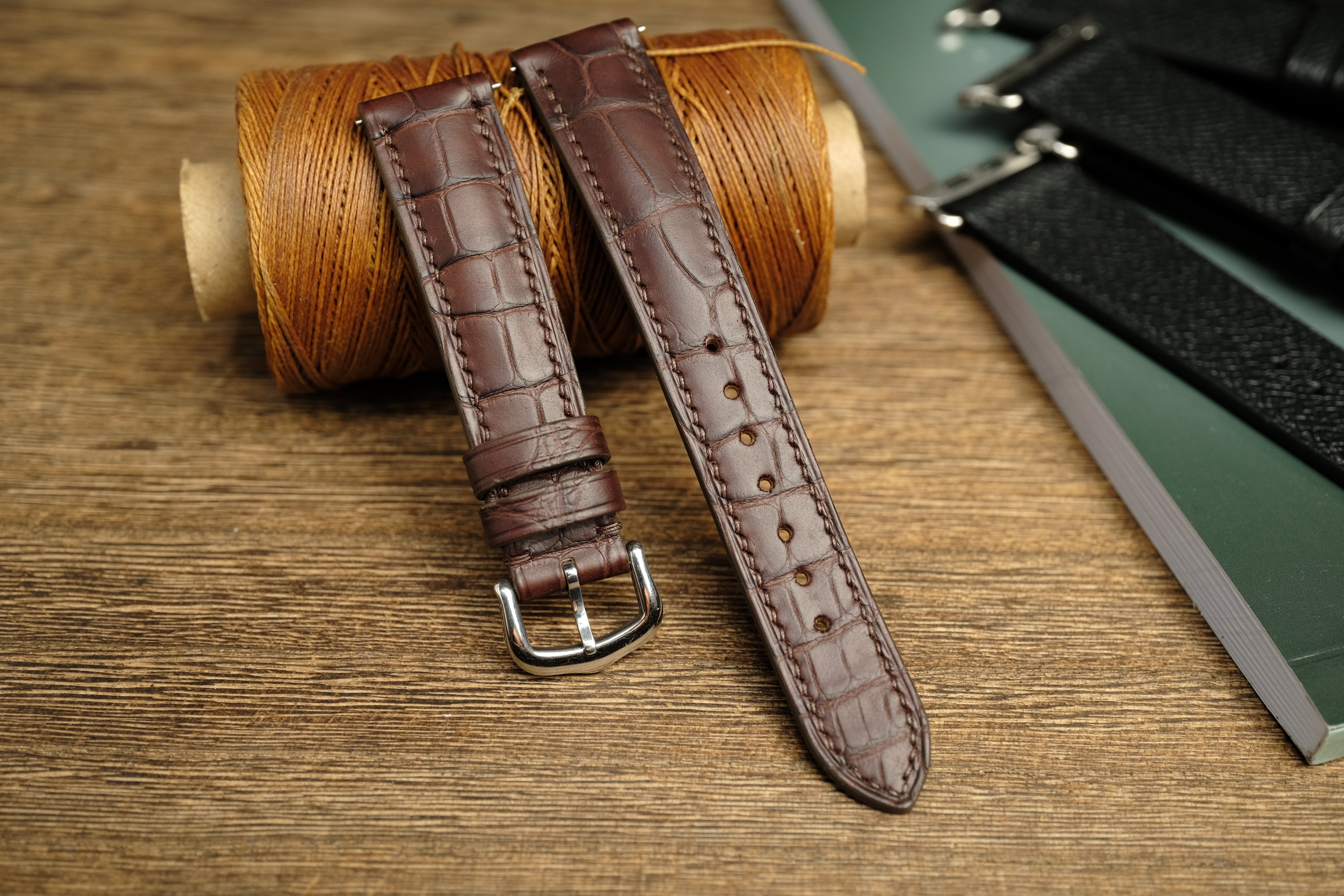
Leather watch straps at AugLeather
Handcrafted in Vietnam · Made-to-order


A watch strap does more than hold a timepiece to your wrist. It defines the entire character of the watch. The right leather can turn a modest dial into something that feels elevated, or give an already distinguished watch the finishing touch it deserves. The wrong choice, and even the most impressive movement gets lost.
Leather remains the material of choice for watch enthusiasts for good reason. It ages beautifully, conforms to the wrist, breathes better than most synthetics, and carries a heritage that rubber and nylon simply cannot replicate. But "leather" covers enormous ground. The species, the tannage, the finish, and the texture all produce wildly different results in terms of feel, appearance, durability, and care requirements.
This guide covers every major type of leather watch strap available today: what makes each one distinctive, what it works best with, and how to care for it properly.
Exotic Leather Watch Straps
Exotic leathers come from non-bovine animals, including reptiles, fish, and equines. They are prized for their distinctive scale patterns, rarity, and the craftsmanship required to work them. If you are building a collection that goes beyond the conventional, exotic leather straps are where the most visually striking options live.
Alligator Leather Watch Strap
Few materials in watchmaking carry more prestige than alligator leather watch straps. Sourced from American alligator (Alligator mississippiensis) or Nile crocodile, alligator leather features large, symmetrical scales with a characteristic belly pattern that runs down the center of the strap. The texture is smooth and firm, with a natural sheen that deepens over time.
Alligator is the go-to pairing for dress watches. Patek Philippe, A. Lange & Söhne, and Vacheron Constantin all ship watches on alligator straps from the factory. The material reads as unambiguously luxurious and suits:
-
Formal and black-tie occasions (glazed finish)
-
Business and smart dress wear (matte finish)
-
Slim cases in precious metals or stainless steel
Care involves keeping the strap dry when possible, conditioning periodically with a reptile-specific leather conditioner, and storing away from direct sunlight. Alligator does not respond well to prolonged moisture or heavy UV exposure.

Lizard Leather Watch Strap
For those who want the refinement of an exotic strap without the bold statement of alligator, lizard leather watch straps offer a quieter alternative. Most commonly sourced from the Java lizard (Varanus salvator), lizard leather features a tighter, more intricate scale pattern. The scales are smaller and more uniform, giving the surface a refined, almost textile-like appearance.
Lizard is noticeably lighter and more supple than most reptile leathers, and it breaks in quickly on the wrist. It bridges smart casual and formal wear without demanding the same level of occasion as alligator. It works particularly well on round dress watches in stainless steel or gold, where the subtle pattern reads as quietly distinguished.
Like all exotic leathers, lizard should be kept away from prolonged moisture. Light conditioning with a reptile-safe product maintains its suppleness and helps prevent cracking at the fold lines.
Snake Leather Watch Strap
Snake leather is one of the most visually dramatic options in the leather strap category. Snake leather watch straps are typically made from python or cobra, each producing a distinct character:
-
Python: Larger, bolder scale patterns with strong visual texture
-
Cobra: Tighter, more geometric scales with a precise, structured appearance
The interlocking scale pattern catches light from different angles, making it particularly striking under indoor lighting. Snake straps work best as a deliberate style choice. They suit fashion-forward watches, statement pieces, or collectors who want something beyond the conventional. They are more delicate than bovine or alligator leathers and require careful handling. The pattern can also vary significantly along a single hide, meaning two straps from the same species may look very different. Many buyers consider this part of the appeal.
Shark Leather Watch Strap
Shark skin, technically known as shagreen, is among the most durable exotic leathers used in strap making. The surface of shark leather watch straps is covered in tiny, calcified nodules called dermal denticles, which give it a rough, sandpaper-like texture unlike any other natural material. This structure also makes it highly resistant to scuffs and abrasion, since the denticles effectively dissipate impact before it can damage the surface.
The aesthetic is masculine and unconventional. Shark straps suit robust sport watches and pilot watches particularly well, adding tactile interest without resorting to rubber. The material is dense and slow to break in, but once it does, it develops a comfortable rigidity that supports the watch well on the wrist. Shark leather is also low-maintenance by exotic leather standards. Its dense structure repels moisture better than most, and light conditioning once or twice a year is generally sufficient.
Premium Bovine and Equine Leathers
Bovine and equine leathers form the backbone of high-end strap production. They offer excellent durability, a wide range of possible finishes, and the accumulated centuries of tannery expertise that made European leather-making famous.

Shell Cordovan Watch Strap
Shell cordovan is the most revered leather in the watch strap world. Shell cordovan watch straps are cut from the fibrous flat muscle beneath the hide on a horse's hindquarters, a section known as the "shell." The material is not split. Instead, it is shaved down through extremely labor-intensive processing at a handful of specialized tanneries, most notably Horween in Chicago and Shinki Hikaku in Japan.
What makes shell cordovan exceptional is its fiber structure. Unlike conventional leather, which folds and develops stress cracks at bend points, cordovan fibers roll and spring back. This means the strap resists creasing in the normal sense and maintains its integrity over decades of use. Other defining characteristics include:
-
A distinctive, waxy luster that deepens with wear rather than wearing away
-
Colors ranging from traditional burgundy and black to whiskey, tan, and navy
-
A deeply personal patina that develops uniquely to each wearer
-
Longevity that often outlasts the watches the strap is paired with
Shell cordovan suits dress watches, field watches, and any piece that will be worn regularly over many years. It rewards long-term ownership above almost any other strap material.

Pueblo Leather Watch Strap
Produced by Conceria Walpier in Tuscany, pueblo leather watch straps are made using a traditional vegetable tanning process. The surface has a distinctive matte, slightly mottled appearance with a dry, chalky feel when new. The texture looks deliberately uneven, rustic in the best possible sense, and the color is applied unevenly by design to create a look that suggests honest craft rather than industrial uniformity.
The patina development on Pueblo is exceptional. The leather starts matte and lightens at stress points as oils from the skin work into the surface. Over months and years, it develops a rich, waxy glow that transforms the strap from rugged to refined. Pueblo works best on:
-
Vintage-style watches with aged or patinated dials
-
Field watches and military-inspired designs
-
Bronze-cased watches where the warm, earthy tones of the leather complement the metal
Togo Leather Watch Strap
Togo leather is a pebble-grained calfskin produced by Tanneries du Puy in France. It is best known as a signature material of Hermès, whose Togo-lined handbags established the leather's reputation for resilience and tactile appeal. For watch straps, togo leather watch straps offer a softer, more relaxed alternative to smooth dress leathers while retaining an unmistakably premium feel.
The fine pebble grain gives Togo good scratch and scuff resistance. Marks tend to blend back into the texture rather than showing as clean lines. It is supple from the start, comfortable on the wrist without requiring an extended break-in period, and available in an unusually wide range of colors due to how well the material accepts dye. Togo works across a broad range of watch styles, including sport watches, field watches, and casual dress watches. It pairs particularly well with textured dials such as guilloché, sunburst, or crosshatch patterns, since the grain echoes the visual complexity of the dial.

Epsom Leather Watch Strap
Another Hermès-associated material, epsom leather watch straps are made from a fine-grain calfskin with a cross-hatched embossed pattern applied under heat and pressure. The finish is stiffer and more structured than Togo, with a subtle sheen and precise, regular texture. It holds its shape exceptionally well and is more resistant to moisture and staining than most uncoated leathers.
The rigidity of Epsom makes it ideal for dress straps where clean lines and a formal appearance matter. It does not soften much with wear, which means it continues to provide firm, even support around the wrist over time. Colors are vivid and consistent, as the embossing process holds dye evenly across the surface. Epsom suits slim dress watches, pocket watch conversions, and any application where a tailored, precise strap silhouette is required.
Swift Leather Watch Strap
Swift leather is a smooth, supple calfskin produced by Tanneries Haas for Hermès. Swift leather watch straps have a polished, even surface with a soft sheen that sits between the matte finish of Pueblo or Togo and the high gloss of glazed alligator. The grain is very fine and barely visible, giving it a nearly smooth appearance that nonetheless retains the warmth and depth of natural leather.
Swift is significantly softer than Epsom and drapes naturally around the wrist from the first wear. It is more susceptible to surface scratches than grained leathers, but minor marks are easy to buff out on such a fine, smooth surface. The material has a refined, understated quality that suits simple, elegant watch designs without competing with the dial. Swift leather also ages gracefully. The patina that develops is subtle but genuine, adding character over time without the dramatic transformation seen in Pueblo or cordovan.

Epi Leather Watch Strap
Epi leather has been a signature material of Louis Vuitton since 1985. It is a textured cowhide with a diagonal, almost wave-like grain pattern applied through embossing. Epi leather watch straps have a firm, polished finish with high resistance to moisture, scuffs, and general wear, all of which comes from the embossing process sealing the surface.
The diagonal grain reads as dynamic and modern, distinct from the regular crosshatch of Epsom or the organic pebble of Togo. It suits sport watches and contemporary designs, particularly watches with angular cases or geometric dials. The durability of Epi also makes it a practical choice for straps that will see daily use without demanding careful handling. It wipes clean easily and requires minimal conditioning to maintain its appearance.
Dollaro Leather Watch Strap
Dollaro leather watch straps are made from a full-grain Italian calfskin with a large, bold pebble grain that is coarser and more pronounced than Togo. The name comes from the rounded, coin-like appearance of the larger grain pattern. The leather is produced primarily in Italy and is associated with quality Italian leather goods traditions.
The oversized grain gives Dollaro a casual, relaxed character that suits sport watches, dive watches, and rugged tool watches particularly well. It is substantial without being stiff, comfortable from the first wear, and the pronounced texture hides minor surface wear effectively. Dollaro straps are often available in saturated, vivid hues that complement bold watch designs. This is a strap leather for people who want something tangibly different from smooth dress leather: an honest, textured material with real physical presence on the wrist.

Vachetta Leather Watch Strap
Vachetta leather is an untreated, naturally tanned calfskin produced without dyes or surface protective coatings. Vachetta leather watch straps start life as a pale, creamy beige and darken dramatically with exposure to sunlight, moisture, and the oils from skin contact. This is the leather that develops the much-discussed "honey patina" familiar to luxury goods collectors, a process that makes every piece unique to its owner.
The tradeoff for this patina development is vulnerability. Vachetta marks easily. Water spots, fingerprints, and any liquid contact will leave a visible change in the surface. Many collectors consider these marks part of the character of the strap; others find the maintenance requirements demanding. The key is accepting that vachetta is a living material that will look quite different at five years than it does on day one. It pairs particularly well with stainless steel cases where the warm patina of the leather contrasts against the cool metal.
Cowhide Leather Watch Strap
Cowhide is the most widely used leather in strap production and, when sourced and processed well, one of the most reliable. Cowhide leather watch straps made from full-grain hide retain the natural surface of the leather, which is the tightest and strongest part of the fiber structure, and they develop genuine character with wear. Corrected-grain cowhide has the top surface sanded to remove imperfections and then embossed, producing a more uniform but less individually expressive result.
For watch straps, full-grain cowhide is the standard of quality. It is versatile across watch styles from field watches to dress watches, available in a vast range of colors and finishes, and durable enough for daily wear without excessive care requirements. A good cowhide strap conditions easily, resists light moisture, and develops a genuine patina over years of use. It is the natural starting point for anyone building a strap collection, offering familiar quality and broad versatility at accessible price points.
Specialty Tanned and Finished Leathers
Beyond species, the tannage and finishing process transforms leather dramatically. The leathers in this section are defined as much by how they are made as by what animal they come from.
Vegtan Leather Watch Strap
Vegetable tanning is the oldest leather processing method still in regular use. Vegtan leather watch straps are made from hides cured over weeks or months using tannins derived from plant matter such as oak bark, chestnut, and quebracho. The process produces a firm, dense leather with a distinctive natural smell and exceptional structural integrity.
Vegtan leather is prized by leather craftspeople and watch enthusiasts alike for several reasons:
-
It accepts hand finishing, burnishing, edge painting, and natural dyes more readily than chrome-tanned alternatives
-
It develops a pronounced patina, darkening significantly with sun exposure and skin oils to produce colors no dye can replicate
-
It is considered the most environmentally responsible tanning method, which matters to a growing number of buyers
-
Tuscany, specifically the tanneries of the Arno Valley, is the world center of quality vegtan production
Straps made from vegtan leather are typically firm when new and soften gradually with wear, ultimately conforming closely to the wrist contour. The break-in period is part of the experience.
Waxy Leather Watch Strap
Waxy leathers are treated with wax compounds during or after tanning, which penetrates the fiber structure and gives the leather a distinctive matte, slightly greasy feel. Waxy leather watch straps often exhibit what is known as a "pull-up" effect: when compressed or scratched, the wax redistributes and leaves a lighter mark that can be buffed away with the warmth of a fingertip. This effect is highly desirable to collectors as it adds visual depth and tells the story of the strap's use over time.
Waxy leather straps are rugged, weather-resistant, and low-maintenance. They suit field watches, military watches, and dive watches particularly well. The wax provides a natural barrier against moisture and light abrasion, and conditioning is straightforward: mink oil, beeswax, or purpose-made leather wax applied sparingly and buffed in will maintain the protective layer and keep the leather supple.
Nubuck Leather Watch Strap
Nubuck leather watch straps are made from top-grain leather that has been sanded or buffed on the outer grain side to produce a soft, velvety nap. Unlike suede, which is split leather buffed on the flesh side, nubuck starts with the strongest part of the hide and retains superior durability while achieving a similar soft-touch aesthetic. The result is a material with a subtle texture, a muted appearance, and excellent tactile quality.
Nubuck straps have a casual yet sophisticated character. They read as relaxed but refined, and they pair well with field watches, pilot watches, and modern sport watches where a clean but not overly formal strap is appropriate. The matte surface absorbs light rather than reflecting it, making colors appear rich and deep. The primary care consideration is moisture susceptibility. A nubuck protector spray applied before first use provides a useful barrier, and a soft suede brush is the right tool for removing surface dirt, since the nap responds better to dry brushing than to a damp cloth.
Suede Watch Strap
Suede comes from the flesh side of a split hide, the inner layer separated from the top grain during processing. Suede watch straps have a soft, fibrous surface with a consistent texture and a naturally matte finish. Suede is notably soft and comfortable from the first wear, requiring no break-in period, which makes it popular for straps worn against the skin for extended periods.
Suede suits casual and smart casual wear. It works well with dress watches worn in informal settings, adding a softness that contrasts elegantly with polished cases. It is also popular for vintage-style watches where the matte texture complements aged dials and patinated cases. Suede requires more attentive care than smooth leather. It should be kept away from rain and heavy moisture, and a suede protector spray significantly improves water resistance. Deep staining is difficult to remove and may require professional cleaning.
Specialty Color and Design Leathers
Some straps are defined primarily by their color treatment or the distinctive visual character that results from specific dyeing and finishing techniques. These leathers may be based on any number of base materials, but the finish is what gives them their identity.
Deep Teal Leather Watch Strap
Deep teal leather watch straps represent one of the most compelling color choices in the current strap market. The color sits at the intersection of blue and green, sophisticated enough for dress wear and distinctive enough to serve as a genuine statement. When applied to quality leather and allowed to develop depth through layered dyeing, teal achieves a visual complexity that flat colors cannot match.
Deep teal works particularly well against stainless steel and white gold cases. It complements blue-dialed watches by providing tonal harmony without matching exactly, and it pairs with green, silver, and champagne dials as a contrasting accent. The color also reads differently under different lighting conditions, appearing more blue indoors and more green in natural light, which gives it an adaptability that solid colors lack. For collectors looking to step away from black, tan, and burgundy without sacrificing versatility, deep teal is an excellent choice.
Himalayan Leather Watch Strap
The Himalayan finish refers to a graduated, multi-tonal color treatment applied to leather, best known from the Hermès Himalayan Birkin, one of the most sought-after luxury accessories in the world. Himalayan leather watch straps mimic the color gradations seen in albino crocodile: a pale, almost white center that deepens through grey and beige toward the edges, creating a naturalistic, cloud-like appearance.
No two straps are identical, as the color graduation is applied by hand and varies between hides. The result pairs most naturally with white, silver, or ice-blue dials and precious metal cases. The pale, cool palette of the strap echoes the refinement of the watch without overwhelming it. This is a collector-level choice, appropriate for significant watches worn on significant occasions and for those who appreciate the artisan finishing process behind each piece.
How to Choose the Right Leather Watch Strap
With nineteen distinct leather types covered above, narrowing the choice requires a clear framework. Consider the following factors:
-
Intended use. A dress watch worn to formal events calls for a different strap than a field watch taken hiking or a diver's watch used for actual water sports. Exotic leathers and smooth finished leathers suit formal and business wear. Waxy, nubuck, suede, and grained leathers suit casual and active wear.
-
The watch's visual character. A slim, round dress watch in yellow gold looks right on a smooth or exotic strap such as alligator, swift, shell cordovan, or Epsom. A bold, angular sport watch with a busy dial can carry a textured strap such as Dollaro, Togo, Pueblo, or waxy leather without the strap competing with the case design.
-
Patina potential. If you want a strap that changes with you over time, choose shell cordovan, Pueblo, vegtan, vachetta, or waxy leather. If you want consistent appearance over time, choose Epsom, Epi, or Togo, whose finishes are more stable.
-
Maintenance willingness. Suede and nubuck require attentive care. Exotic leathers need conditioning and moisture avoidance. Waxy and grained bovine leathers are the most forgiving for everyday wear without extensive upkeep.
-
Color choice. Tan and brown leathers are the most versatile. Black suits formal occasions. Deep teal, Himalayan, and unusual colors make stronger style statements and work best when built around a specific watch and outfit combination.
Leather Watch Strap Care: General Principles
Regardless of leather type, a few care principles apply broadly to all straps:
-
Avoid prolonged moisture exposure. Leather is treated animal skin. Extended contact with water weakens the fiber structure, promotes mold, and accelerates surface damage. Remove straps before swimming, showering, or activities that cause heavy perspiration.
-
Condition regularly. Leather dries out and becomes brittle without occasional conditioning. Once every three to six months is appropriate for most straps under regular wear. Use conditioners formulated for the leather type: reptile conditioner for exotic leathers, leather balm or beeswax for bovine leathers, and specialist products for suede and nubuck.
-
Rotate your straps. No single strap benefits from being worn every day without a break. Rotating between two or three straps extends the life of each and allows the leather to dry and recover between wears.
-
Store properly. Keep straps in a cool, dry place away from direct sunlight. UV exposure fades dyes and dries out leather. A strap roll or dedicated storage box is worth the investment for higher-value straps.
-
Replace when necessary. Even the best leather strap has a finite life. When stitching begins to unravel at the fold, when the liner separates, or when the leather at the first hole begins to crack through, it is time to replace the strap rather than risk the watch falling from your wrist.
Frequently Asked Questions
What is the most durable leather watch strap?
Shell cordovan is widely considered the most durable leather strap material. Its unique fiber structure resists the creasing and cracking that would compromise other leathers, and well-maintained cordovan straps often outlast the watches they are paired with. Among more accessible options, full-grain cowhide and waxy leather also offer excellent longevity.
What leather watch strap is best for a dress watch?
Alligator leather is the traditional choice for dress watches and remains the most prestigious option. Shell cordovan, swift leather, and Epsom leather are excellent alternatives that offer a range of price points and aesthetics while maintaining a refined appearance appropriate for formal wear.
Which leather watch straps handle moisture best?
No leather watch strap is truly waterproof, but some handle incidental moisture better than others. Waxy leather, shark leather, and heavily finished leathers like Epsom offer the best resistance. For regular water exposure, a rubber or NATO strap is a more practical choice.
What is the difference between suede and nubuck?
Both have a soft, velvety surface but come from different parts of the hide. Nubuck is top-grain leather sanded on the outer side, retaining the strength of the strongest part of the hide. Suede is split leather buffed on the flesh side, which makes it softer and lighter but less durable. For watch straps, nubuck is generally the more hard-wearing option.
Do leather watch straps develop a patina?
Yes. Most genuine leather straps develop a patina over time through exposure to light, skin oils, and general wear. The degree varies significantly by leather type. Vachetta, shell cordovan, Pueblo, and vegtan leather develop the most pronounced and desirable patinas. Finished leathers like Epsom and Epi develop subtler changes. The patina on a quality leather strap is one of its most appealing features. It makes the strap uniquely yours.
—
Next steps
- Watch Strap Color Rules — once you've chosen your leather, learn how to colour-match it to your watch.
- Watch Strap Measurement Guide — get the sizing right before you order.
- Browse the full leather watch strap collection — shop by material, colour, or watch brand.
Share:
Leather Oil For Leather Watch Strap Guide
Watch Strap Color Rules - Choose Color For Your Watch Strap