

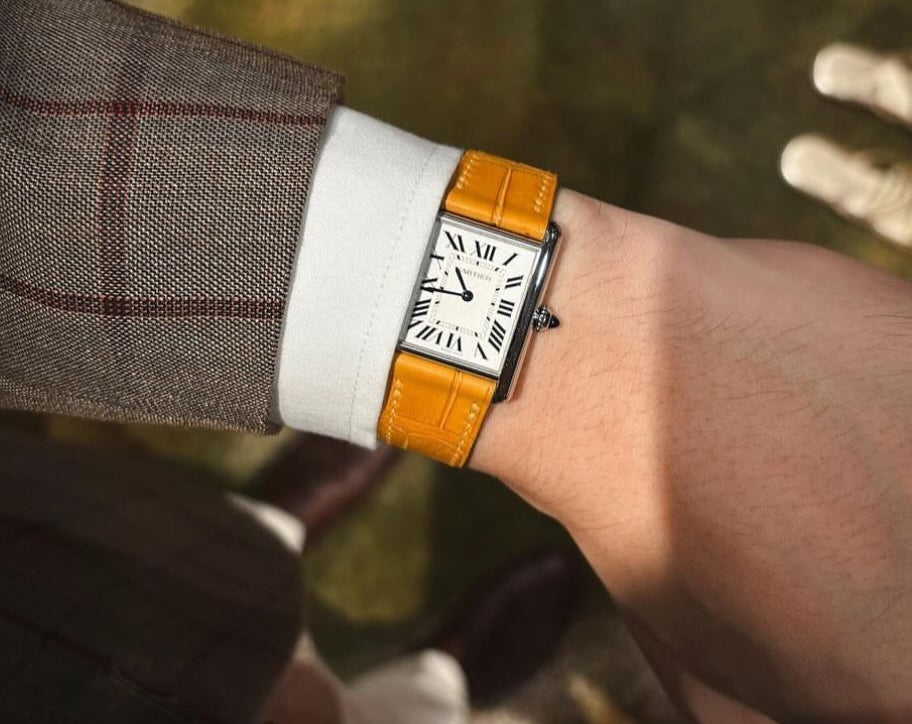
Quick-release leather watch straps at AugLeather
Handcrafted in Vietnam · Made-to-order


Changing a watch strap takes less than five minutes once you know how. You do not need a watchmaker. You do not need special training. You need two tools and a flat surface.
This guide walks you through the process from start to finish.
Why Change Your Own Strap
Taking your watch to a shop for a strap change costs money and time. Doing it yourself saves both. Plus, you can switch straps to match your outfit, your mood, or the season. A single watch becomes three different watches with three different straps.
What You Need
Required tools:
- Spring bar tool (also called a spring bar remover)
- Soft cloth or watch pad
- Your new leather strap
Optional but helpful:
- Tweezers for handling small parts
- A small bowl to hold spring bars
- Good lighting
About the spring bar tool:
- Inexpensive tool with a forked end and pointed end
- Forked end removes straps
- Pointed end adjusts bracelets
- For leather straps, you only need the forked end
- Available online for under $10
Before You Start
Check your lug width:
- Measure the distance between your watch lugs
- Or check the back of your current strap
- Common sizes: 18 mm, 20 mm, 22 mm
- Your new strap must match exactly
Prepare your workspace:
- Work over a table with a cloth underneath
- Avoid drains, gaps, or shag carpet
- Spring bars are small and easy to lose
Protect your watch:
- Lay your watch face down on the soft cloth
- Prevents scratches to the crystal or case back
Step 1: Remove the Old Strap
Locate the spring bars:
- Small metal pins that hold your strap between the lugs
- Spring-loaded, so they compress to fit into lug holes
Position your tool:
- Hold the watch steady with one hand
- Insert the forked end between the strap and the lug
- Catch the shoulder of the spring bar (the raised ring near the end)
Compress and release:
- Gently push the spring bar inward toward the center
- This compresses the spring
- While maintaining pressure, angle the tool to guide the spring bar out
- The strap should pop free on that side
Complete the removal:
- Repeat on the other side using the same process
- Once both spring bars are free, remove the strap
- Save the spring bars as backups
- Place them in a small bowl so they do not roll away
Step 2: Prepare the New Strap
Check the spring bars:
- If your new strap came with spring bars, check that they move freely
- They should slide in and out with spring tension
- If they stick or feel loose, replace them
Insert spring bars if needed:
- Insert through the hole at each end of the strap
- Ends should protrude equally on both sides
Orient the strap correctly:
- Short piece with buckle: attaches to 12 o'clock position (top)
- Long piece with holes: attaches to 6 o'clock position (bottom)
- This orients the buckle correctly for putting on your wrist
Step 3: Install the New Strap
Start with one side:
- Hold the watch case in one hand
- Insert one end of the spring bar into the lug hole
Compress and insert:
- Use your spring bar tool to compress the exposed end
- Guide it between the lugs while keeping the other end in its hole
- The spring bar should slide into the opposite lug hole
Listen for the click:
- You may hear or feel a small click
- This means the spring bar has expanded and locked in place
Check the fit:
- Gently tug on the strap
- It should feel secure with no wobble
- The strap should pivot naturally but not slide in and out
Complete the installation:
- Repeat for the other side using the same process
- Remember: buckle at 12 o'clock, holes at 6 o'clock
Step 4: Final Inspection
Check both sides:
- Verify both spring bars are seated properly
- Give each strap end a firm but gentle tug
- Neither should pull free
Test the buckle:
- Fasten the strap on your wrist
- The buckle should engage smoothly
- The strap should feel comfortable, not too tight or loose
Check alignment:
- Look at the watch from the side
- The strap should sit centered between the lugs
- Equal space on both sides
- If crooked, one spring bar may not be seated properly
Troubleshooting Common Problems
Problem: Spring bar keeps popping out
- Cause: Spring bar is too short for your lugs
- Solution: Try the original spring bars from your old strap
Problem: Strap feels loose or wobbly
- Cause: Spring bar not fully seated in lug hole
- Solution: Remove and reinstall, listening for the click
Problem: Cannot compress the spring bar enough
- Cause: Stiff spring bar or wrong tool position
- Solution: Make sure tool catches the shoulder, not just the end
- Apply steady pressure rather than quick jerks
Problem: Strap is crooked
- Cause: One spring bar seated deeper than the other
- Solution: Remove and reinstall crooked side evenly
Problem: Lost a spring bar
- Check the floor, cloth, and nearby surfaces
- Spring bars are cheap to replace
- Keep extras on hand for next time
Tips for Success
Use the right tool:
- Small screwdriver or knife can work but risks scratching
- Spring bar tool is designed for this job
- Worth the small investment
Work in good light:
- You need to see small spring bars and lug holes clearly
- A desk lamp helps enormously
Take your time:
- Rushing leads to dropped parts and scratched watches
- The process requires some dexterity
- Go slow until you get the hang of it
Practice first:
- If nervous, practice on a cheap watch
- Skills transfer exactly to your prized timepiece
Keep spare spring bars:
- Buy a pack of assorted sizes
- Inexpensive and save you when one goes flying
When to See a Professional
See a watchmaker for:
- Integrated straps: High-end watches with case-integrated designs
- Screwed lugs: Watches using small screws instead of spring bars
- Vintage watches: Old watches with fragile lugs or non-standard fittings
- Personal comfort: If the process makes you anxious, professionals charge small fees
Caring for Your New Leather Strap
Break it in gradually:
- New leather is stiff
- Wear for a few hours at first
- Gradually increase wear time
- Leather will soften and conform to your wrist
Avoid water initially:
- Let leather settle for one week
- Then expose to moisture
- Helps strap maintain its shape
Condition occasionally:
- Apply leather conditioner every few months
- Keeps strap supple and prevents cracking
Rotate your straps:
- If you own multiple straps, rotate them
- Extends life of each one
- Lets them dry out between wears
Final Thoughts
Changing a watch strap is a simple skill that pays off every time you want a new look. With practice, you will do it in under two minutes. Your watch collection effectively multiplies without buying new watches.
The key is having the right tools and working carefully. Invest in a spring bar tool. Work over a soft cloth. Take your time. Soon you will wonder why you ever paid someone else to do this.
Ready to try a new strap? Browse our collection of handcrafted leather watch straps and give your watch a fresh look today.
—
Find your replacement strap
- Browse leather watch straps — find your replacement by material, colour, or lug width.
- Best-selling watch straps — start with what other customers trust most.
- How to clean a leather watch strap — keep your new strap looking great from day one.
Share:
Watch Strap Measurement Guide: How to Get the Perfect Fit
Leather Strap vs Metal Strap Watches: Which Should You Choose